
News

News

Links’ List of Multiples | DECEMBER 2025

The CVCA recently announced Canada posted a record $56.5 billion in private equity investment through the first nine months of 2025 across 483 transactions, with an average deal size of $117 million, driven by 9 mega-deals, including five above $3.3 billion. It is an impressive headline, but it obscures the underlying reality.  When the 9 deals over $500 million are removed, the mid-market tells a very different story. Through Q3 2025, Canada recorded 474 sub-$500M transactions totalling $5.14 billion, with a YTD average deal size of $10.8 million, the lowest mid-market average compared to any year in the past decade. For context, the 2021 mid-market peak saw $13.8 billion invested, averaging $17.4 million per deal. Even the softer markets of 2023 and 2024 posted higher averages at $12.7 million and $14.0 million, respectively.

Links’ List of Multiples | DECEMBER 2025 Read More »

Links’ List of Multiples | SEPTEMBER 2025

Valuations Normalizing After Years of Elevation

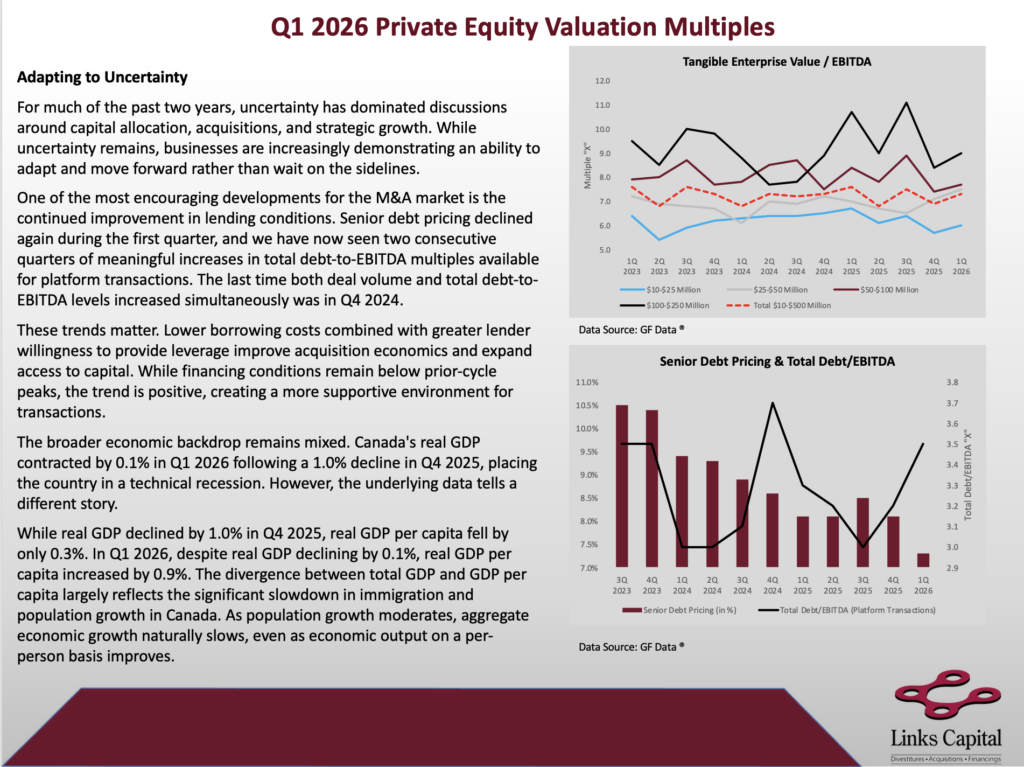
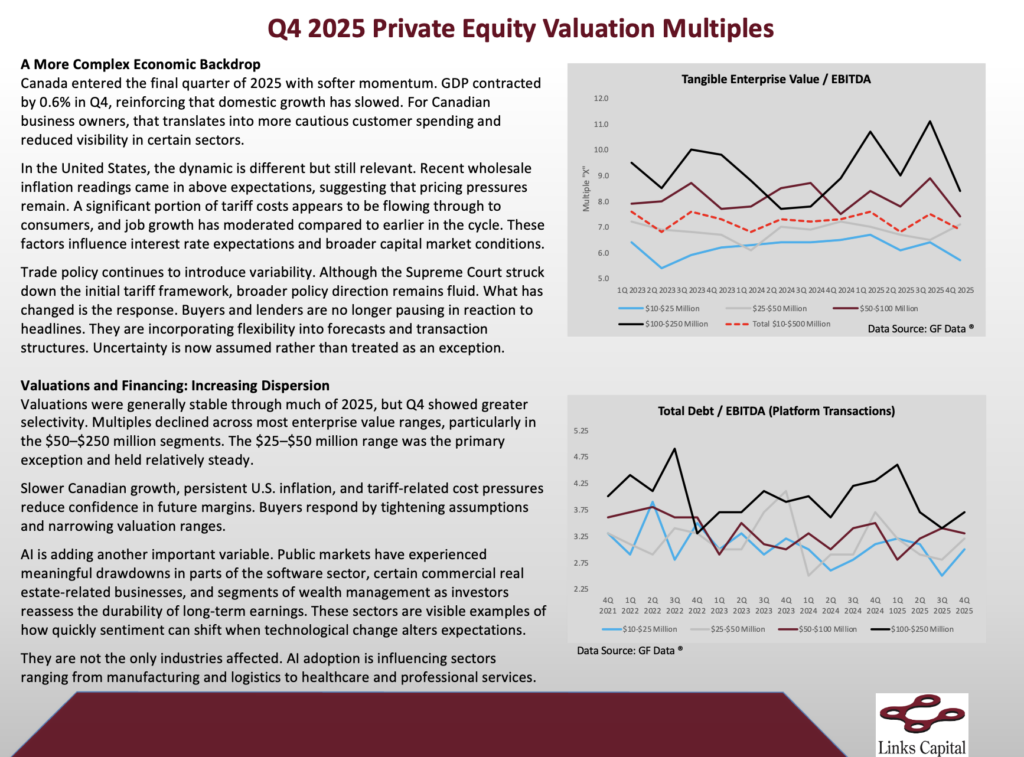
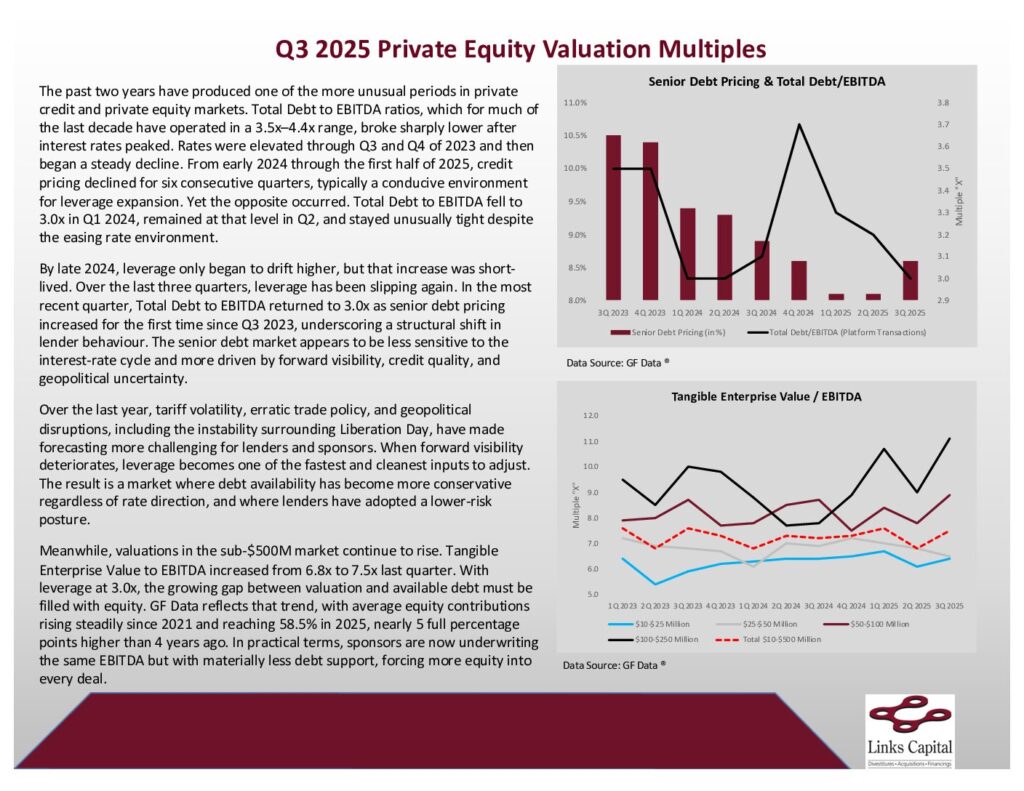
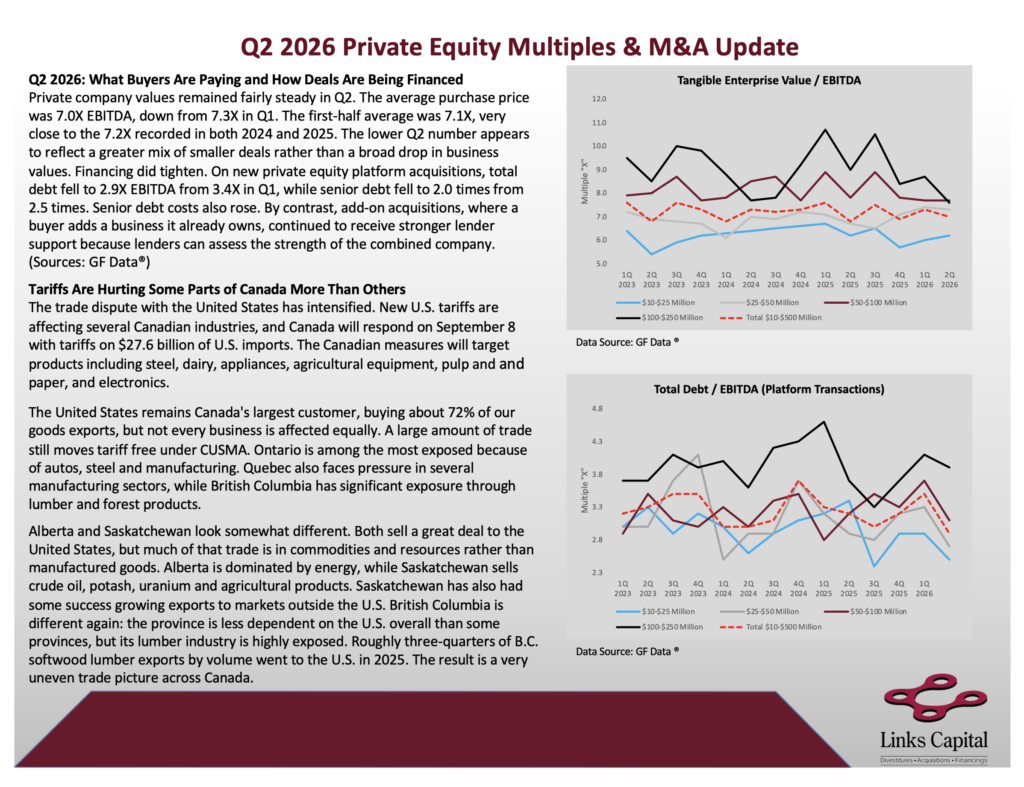
In transactions ranging from $10 million to $250 million, we are seeing multiple compression compared to the previous quarter. Valuations are now tracking close to long-term averages after several years of elevated levels.

Alongside valuation pressure, senior debt multiples have contracted to an average of 2.0x EBITDA on platform transactions — the lowest since COVID. Bankers are signaling caution as inflation once again shows signs of life in the U.S., tightening their risk tolerance. According to GF Data, deal activity in the first half of 2025 is down 30% from 2024, underscoring a more selective environment for buyers and lenders alike.

Links’ List of Multiples | SEPTEMBER 2025 Read More »

Links’ List of Multiples | JUNE 2025

Uncertainty Reigns Amidst Tariff Whiplash and Political Crosscurrents

Recent developments in global trade policy, most notably U.S. tariff announcements, have introduced a heightened level of uncertainty for private company transactions, particularly those with cross-border exposure. The U.S. President’s Liberation Day speech, where he revealed a new round of tariffs without a clear economic rationale, has left investors and businesses alike grappling with what many now refer to as the “TACO trade” an acronym capturing the sentiment that “Trump Always Chickens Out.”

Indeed, the pattern of announcing tariffs and then scaling them back, delaying them, or abandoning them altogether has created a volatile environment. Many private equity funds and strategic buyers we work with continue to view the President’s tariff stance as more posturing than policy. While new tariffs were announced for specific countries and sectors, the general consensus is that actual implementation may fall far short of the sweeping measures outlined in the Liberation Day chart. Some regions may see tariffs materialize, while others may escape unscathed. Nonetheless, critical sectors such as steel, auto parts, and potentially lumber remain under pressure, creating tangible risks for affected businesses.

Links’ List of Multiples | JUNE 2025 Read More »

Links’ List of Multiples | MARCH 2025

Navigating M&A in Turbulent Times: Understanding the Current Landscape

In today’s complex and rapidly shifting M&A environment, business owners traditionally rely on established valuation metrics and market trends. However, given current geopolitical challenges, these conventional indicators appear less relevant for Canadian companies. To provide a clearer perspective, we have characterized today’s M&A landscape using the acronym TRUMP, reflecting current key market factors affecting deal-making and investment decisions.

T – Tariff Threats

The looming prospect of U.S. tariffs has created significant uncertainty for Canadian businesses engaged in cross-border transactions. Recently, the U.S. administration announced plans to impose a 25% tariff on Canadian and Mexican imports, alongside new tariffs of up to 20% on Chinese goods. These policies, driven by concerns over trade imbalances, border security, and the fentanyl crisis, add complexity to trade and investment strategies.

An executive order reviewing existing trade agreements suggests additional tariff measures may follow, including reciprocal tariffs set to take effect in early April. For Canadian companies, these trade barriers raise the cost of exporting goods to the U.S., dampening appetite for acquisitions, business expansions, and overall economic viability, particularly for firms heavily reliant on U.S. markets.

Links’ List of Multiples | MARCH 2025 Read More »